

How We Automated Cold Email Outreach for a UK SaaS Client Using AI (n8n + Perplexity + Notion)
Cold email outreach is one of the highest-ROI channels for B2B SaaS companies — and one of the most time-consuming. Researching prospects, writing personalised emails, logging everything to a CRM: done manually, this process eats hours every single day.
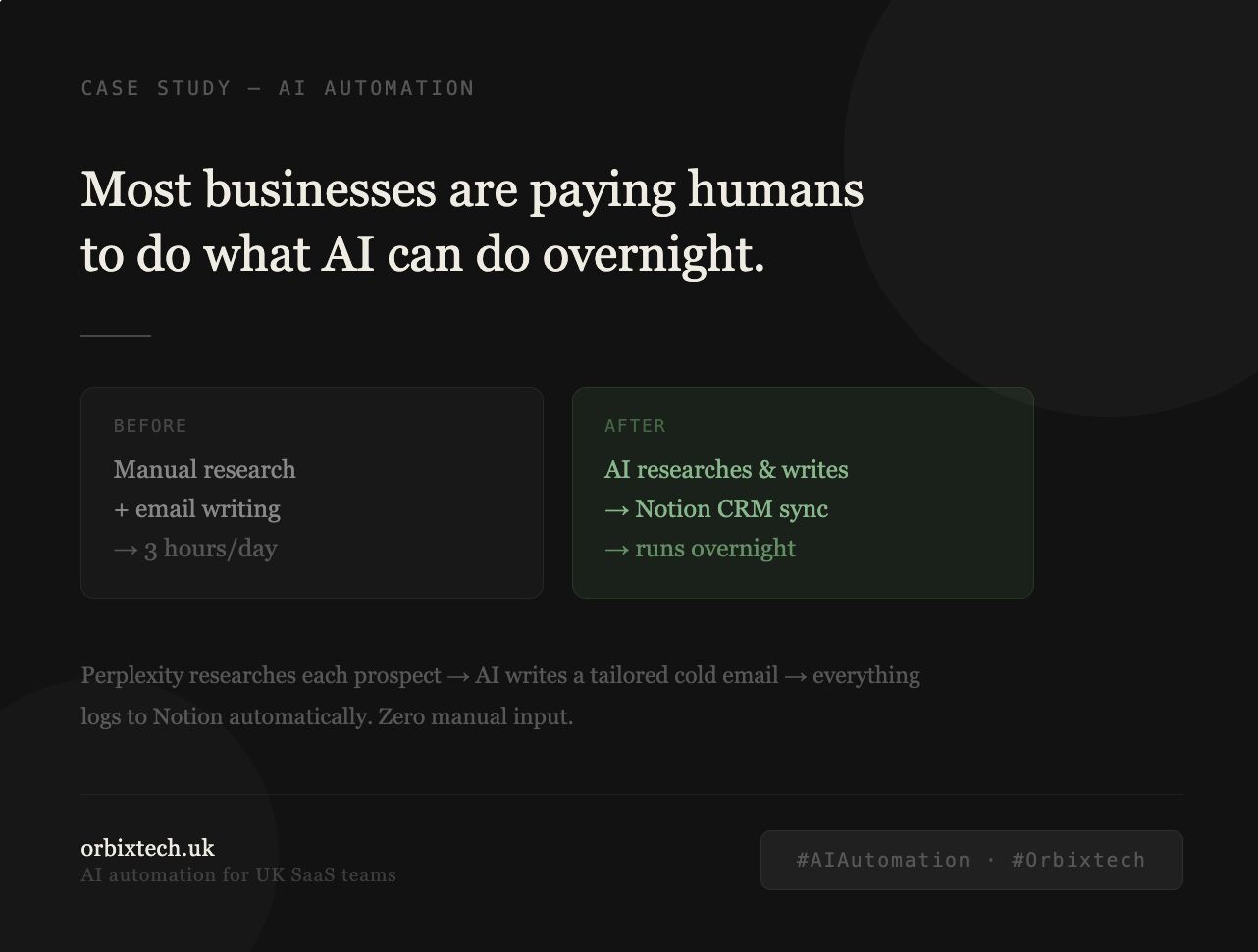
We recently built a fully automated AI outreach system for a UK SaaS client that reduced their manual prospecting time from 3+ hours per day to near zero. Here's a detailed breakdown of what we built, the tools we used, and what results it produced.
The Problem: Personalised Outreach Doesn't Scale Manually
Our client runs a 12-person SaaS company targeting UK businesses in the operations and logistics space. They had a solid ICP (ideal customer profile), a clean target list from Apollo.io, and a proven email sequence — but their small team was spending 3–4 hours daily just on research and first-draft writing.
The core bottleneck: personalised cold emails require knowing the prospect. Generic templates get ignored. But proper research — reading the company website, checking LinkedIn, understanding their pain points — takes 20–45 minutes per prospect.
At 15 prospects per day, that's over 3 hours. Not sustainable for a lean team.
What they needed: a system that could research prospects automatically and produce ready-to-review personalised cold emails at scale, without sacrificing quality.
The Solution: AI Research + Email Generation + Notion CRM Sync
We built an end-to-end automation workflow in n8n (a self-hosted workflow automation tool) that handles the full outreach preparation pipeline:
- Pulls prospect data from a target list
- Runs AI-powered research via Perplexity API
- Generates a personalised cold email using OpenAI GPT-4
- Logs everything to a Notion CRM database automatically
The entire workflow runs on a schedule — overnight, or on demand — with no manual input required beyond reviewing and approving the output.
How the Workflow Works (Step by Step)
Step 1: Prospect Input
The workflow reads from a structured input source — in this case, a Google Sheet populated from Apollo.io exports. Each row contains: company name, website URL, industry, employee count, and LinkedIn URL.
Step 2: AI Research via Perplexity
For each prospect, the workflow sends a structured prompt to the Perplexity API. Perplexity is a real-time AI search engine — unlike GPT-4 alone, it actively searches the web and synthesises up-to-date information about the company.
The prompt asks Perplexity to return a structured brief with eight fields:
- WHAT THEY DO — core business summary
- STRONGEST POINT — what they do well
- BIGGEST COMPLAINT — common customer frustrations (pulled from reviews, forums, social)
- SOLUTION — what we'd offer them
- TOOLS — likely tech stack
- OUTCOME — measurable result we can promise
- COMPLEXITY / BUILD TIME — internal scoping estimate
This brief becomes the raw material for the email.
Step 3: Cold Email Generation
The research brief is passed to GPT-4 with a tightly engineered prompt. The model writes a cold email that:
- Opens with a specific, research-backed observation about the company
- Identifies one operational pain point by name
- Positions our client's solution as the direct fix
- Ends with a low-friction call to action (15-minute call)
No placeholders. No merge tags. A genuine, context-aware email written from scratch for each prospect.
Step 4: Notion CRM Logging
Free Strategy Session
Want this built for your business?
We'll map out your exact automation roadmap in a free 30-minute call. No contracts, no commitments.
Both the research brief and the generated email are written to a Notion database automatically. Each entry includes the prospect details, the full Perplexity research output, the draft email, and a status field (Draft / Reviewed / Sent).
One technical constraint worth noting: Notion's API has a 2,000-character limit per block. For longer research outputs, we implemented a chunked appending function in the n8n workflow that splits content across multiple blocks seamlessly.
The team reviews emails directly in Notion, makes any edits, and marks them as ready to send — all in one place.
Results
After running the system for the first full month:
- Prospect research time: reduced from ~45 min to ~2 min per company (human review only)
- Daily outreach capacity: increased from 15 to 80+ prospects
- Email quality: consistent across all prospects — no degradation at volume
- Reply rate: improved compared to previous generic template campaigns
The team now spends their time reviewing and approving, not researching and writing. The highest-value human judgment — deciding who's worth pursuing and whether the email sounds right — is preserved. The low-value repetitive work is fully automated.
Tools Used
| Tool | Role |
|---|---|
| n8n | Workflow automation and orchestration |
| Perplexity API | Real-time prospect research |
| OpenAI GPT-4 | Cold email generation |
| Notion API | CRM logging and review workflow |
| Apollo.io | Prospect list source |
| Google Sheets | Input data staging |
Who This Is For
This type of AI outreach automation works well for:
- B2B SaaS companies doing account-based outreach to a defined ICP
- Agencies that pitch new clients regularly
- Consultancies targeting specific industries
- Any team spending 2+ hours daily on manual prospecting research
The workflow is not about sending more emails blindly. It's about making every email worth sending — and removing the manual work that currently limits how many you can send well.
What This Isn't
This system doesn't replace human judgment. Every email is reviewed before sending. The AI produces a strong first draft based on real research humans decide whether it's right, and make adjustments where needed.
It also doesn't work without a clear ICP. The research quality depends heavily on the prospect list quality. Garbage in, garbage out.
And it's not a mass-blast tool. It's designed for targeted, high-quality outreach at a scale that was previously impossible for small teams.
Build This for Your Team
We build AI automation systems like this for 5–20 person SaaS and e-commerce companies across the UK. If your team is doing manual prospecting research, we can likely cut that time by 80–90% with a similar system.